Turning a molehill into a mountain: How I turned a little problem into a huge business deal Part 2/2
Part two: how a dinner in Ihringen turned a bike favor into JobRad's Salesforce transformation — and secured a future for Valuent.
In Part 1, I shared the story of how I got a big lead early on in running Valuent, in a way I never could have predicted. This is the story of how I closed the deal with Holger and JobRad and secured a future for my company.
At the time I’d connected with Holger, Valuent was six months old, and we were used to winning clients without collaborating with Salesforce–I had never even met someone from the company by this point. But a few hours after I logged the JobRad lead, I got a call from Michael Dzewas, the Salesforce Account Executive responsible for that account. Turns out he was also excited about JobRad, he had first read about them two years earlier and had been trying to win them as a customer since! I told him about our upcoming dinner with the CEO and his soon to be appointed CTO in Freiburg, and the challenges Holger faced. We agreed I’d update Michael after the dinner.
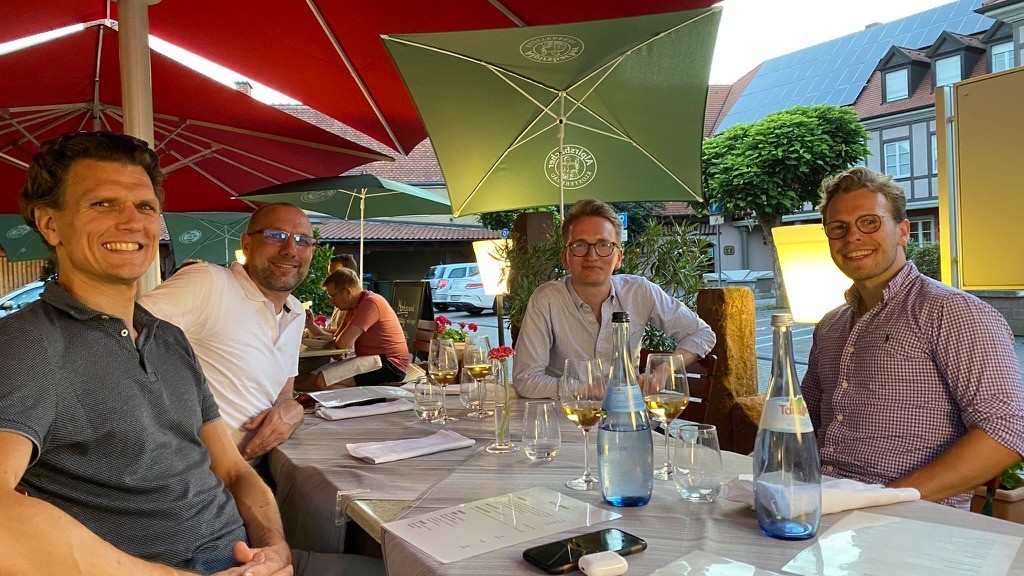
Some of you might recognize Ihringen because of the good wine, or because it’s known as the hottest place in Germany. And Ihringen did not disappoint, 37 degree Celsius and trust-based apple sales in front of half-timbered houses welcomed us. After checking into the local hotel (without air conditioning) David and I took a walk to Restaurant Holzöfele (some of the best liver I’ve ever had) where we would meet with Holger and Matthias that evening. We got a table outside and saw Holger arriving on his Drahtesel. Good, so the man is serious about bikes!
Holger sat down, along with the soon-to-be CTO Matthias, and over four glasses of white wine (the first time I saw David drink alcohol), they told us their story: two down-to-earth guys with the ambition and vision to bring millions of people on to the bike in Germany. Matthias was a Chemistry PhD, who started building software as a hobby to streamline processes at his church, and then joined JobRad where he was now joining the Geschäftsleitung, with a vivid vision of how to build a more agile digitalization organization to support the crazy growth of JobRad.
Before starters arrived we got into the weeds. They were around 350 people at the time and planning to grow to 1,000 within the next three years (which they did). They shared their growth pains, which David and I knew first-hand from working for Rocket Internet and Enpal in Berlin. Holger told us, when people call about the status of an order, “I want the phone system to automatically know who they are, anticipate what they want and answer their question without human involvement,” so that customer service reps can focus on higher value-add tasks and not get swamped in routine requests that can be automated. Holger went on to describe how handicapped they were by the technical debt of their existing system. We learned that they had an Odoo team of around 50 people who just worked on maintaining the existing platform to not blow up in the face of growth. At some point they even acquired their Odoo partner to add capacity. How it was a politically sensitive topic, because their Odoo team was really entrenched with the system and not open to new technology. For Holger it was clear they needed something new in order to support their next phase of growth.
We told them we worked with Salesforce because it is all about growth. Any company that scales will at some point not get past Salesforce. If they scale, it’s not a question of whether they will get Salesforce, it’s just a question of when.
For JobRad, it seemed like now was the time. We told them we don’t believe in slides and technical requirements—our work with companies is completely specific to their needs and current situation–not a one-size-fits-all model. How does this business work, and not work? What are the ultimate outcomes that they are trying to achieve; what is the current process and what is the desired process? From there, we plan a workshop with the service and technical teams, and shadowing sessions with their customer service. This is how we figure out, together, the company’s most pressing needs and growth goals and how Salesforce can help.
Salesforce has a striving ecosystem. They’ve created a movement over the past 25 years and it’s fun to be part of that. When Salesforce is done right, it has superb usability and the speed at which you can digitize and automate processes is second to none. Especially since it can be done by people with in-depth business understanding because of the ease of accessibility of the low-code platform. And combine all of that with a scalable infrastructure, platform governance limits that ensure you maintain the scalability, three yearly updates that bring Salesforce innovation to its global customer base of 180K+ customers.
And what most people don’t know is, you can start super small with Salesforce, and grow into it as needed. This is why it makes sense to work with a trusted Salesforce consulting partner, so they can guide you to the capabilities you need. For example, in the beginning you might configure everything right in the org, when you have 10 users. But when you grow to 30 or more users you want a dev org to run tests before deploying changes to the production org. That is why Salesforce orgs come with sandbox and developer orgs that allow you to test new features and integrations in a controlled environment before rolling them out.
David and I shared with Holger and Matthias that our approach to business is one of partnership, and we only want to do this with them if we believe we want to work for many years together and it’s a win-win. Of course that doesn’t mean we have to work forever, but long-term is the intention. Holger asked what would happen if JobRad outgrew the partnership with Valuent, and I explained that separation is part of the beauty of working with the Salesforce CRM: you have a vital and big ecosystem of capable partners that can support you. “But,” I admitted, “Our plan is to outgrow you!”
Finally, we discussed the timeline. Of course, it all depends–in theory Valuent would be able to get something meaningful done in 8-10 weeks, given the size of JobRad’s customer service at around 50 users. But you need to focus on what is most important for the first iteration, because the sooner we get a version into the hands of the users that is ideally as good as what they currently have or better and (significantly better in two or three important aspects), the faster we can iterate and the bigger the impact of Salesforce CRM is.
We proposed a workshop to align their CRM goals with a practical roadmap of the CRM implementations’s first phase, its costs, timeline, and resource requirements, ensuring a smooth transition. Our user training helps guarantee high adoption and success. We agreed to their goal to have a pilot program running by the end of the year.
As David and I walked back to the hotel, we both glowed like a fire had been lit–and it wasn’t just the heat that had lingered late into the night. I remember being moved by my co-founder’s total conviction when he said: “Matthias is cool and Holger is super visionary. We both know we can help them.”
If you’ve made it this far and you want to know how it all worked out, I’ll tell you! We set up a two-day workshop in Freiburg together with Salesforce and JobRad. We arrived at JobRad’s meeting room embedded into nature, with high ceilings and big windows. Holger set the scene in the beginning, JobRad management actively participated, an agile coach, a dedicated project manager and customer service team members were part of that workshop. We looked over the shoulder of an existing customer service rep and what they had was super basic (essentially an Outlook inbox)—no wonder the 50 customer service reps were struggling to keep up with the case volume! They were missing all the basic customer service tools like automatic case routing, shortcuts, email templates within the ticketing context, as well as the customer context data, like what bike had been ordered and what company the purchaser worked for. All of that had to be looked up in a separate system. This context-switching is a huge productivity killer and a source for errors in customer case handling. It was satisfying to see all of this and know how we would be able to transform their business. And in the evenings we had dinner together, getting to know each other, and building trust.
When the workshop was over, we were well on our way to designing a solution for JobRad that allowed them to handle service cases much more efficiently, deflect many would-be cases through better FAQs, ChatBot, and having access to the customer data, which reduced errors in handling duplicate cases by different team members. They had a solid foundation to grow on. Salesforce took care of the customer service piece, allowing them to take that piece out of their monolithic Odoo system, reducing load on the system and re-allocate Odoo resources to other projects internally, now that the service piece was handled in Salesforce Service Cloud–a system that is much more flexible, scalable and faster to iterate on with much lower maintenance cost.
Over the coming months we added features and use cases to further streamline the customer service processes. I appreciate the tight collaboration and iterative approach that we took together.
Looking back, there was no way for me to know that this partnership would be the result of an employee’s request for help getting a bike he thought was cool. And getting to know a founder and leadership team, understanding what their pain points are, what their needs are and sculpting a mutual way forward–the unexpected paths are the most fun and rewarding.
This was just the first project we did with JobRad, many have followed over the years… But one was more exciting than all the others. Holger had plans in Austria, and wondered whether Salesforce could help him build the digital backbone for their entire business. Now that’s a challenge. Could we and Salesforce handle that?