Kebabs to Vietnam Part 3/3: From freelancers to founders — the story of our first big win
Part three of the Valuent founding story: from freelancers to founders, and the story of our first big win.
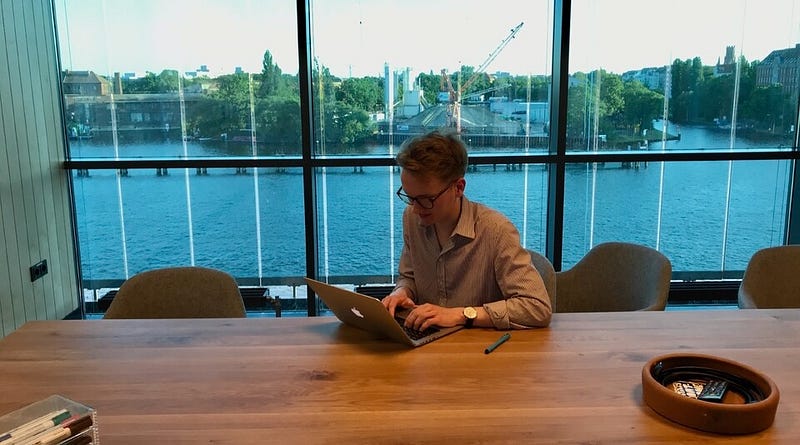
David at Stralauer Allee meeting room — Thanks WeWork and Adam Neumann ;-)
In Part 1, I told you how me and my business partner David stumbled onto the idea we built our company around. In Part 2, I told you how we turned that idea into our first paid job and how we got introduced to a potential big Salesforce Service Cloud project. We knew that to deliver that project successfully, we needed help. And we needed help fast. So now I’m going to tell you how we got help and moved from wannabe entrepreneurs to serious business.
David and I are at the WeWork on Stralauer Allee, in an empty conference room we did not pay for. We look outside onto the sunny weather and the Spree. And David comes up with this fantastic plan that some guy — “Pavel from Belarus” — might be able to help.
And things were getting serious, the tech team from the client is located in Lithuania, they wanted us there next week. David calls up Pavel.
A deep voice, cloaked in a Russian accent: “Hullo.” David explains the situation and the opportunity we have in front of us, to which the voice responds with a sober, “Ok.”
I look at David with a big question mark on my face. This is the guy that we want to rely on to get the job done? He’s said two words in ten minutes! I felt like we were bringing light to this guy. David shrugs, so I jumped in and introduce myself. “Hey Pavel, good to meet you, this is David’s business partner Dennis. So like David said, this is a huge opportunity and we need someone who can build the integration with the customer’s backend to sync millions of customer records. Can you help us with that?”
Silence. And then,
“Ok.”
“Ok Pavel, can you be in Lithuania with me next week to meet the client?”
“Yes, need to check with Visa.”
“Good. I want to meet you before then, are you free tomorrow to meet in Minsk?”
“Ok.”
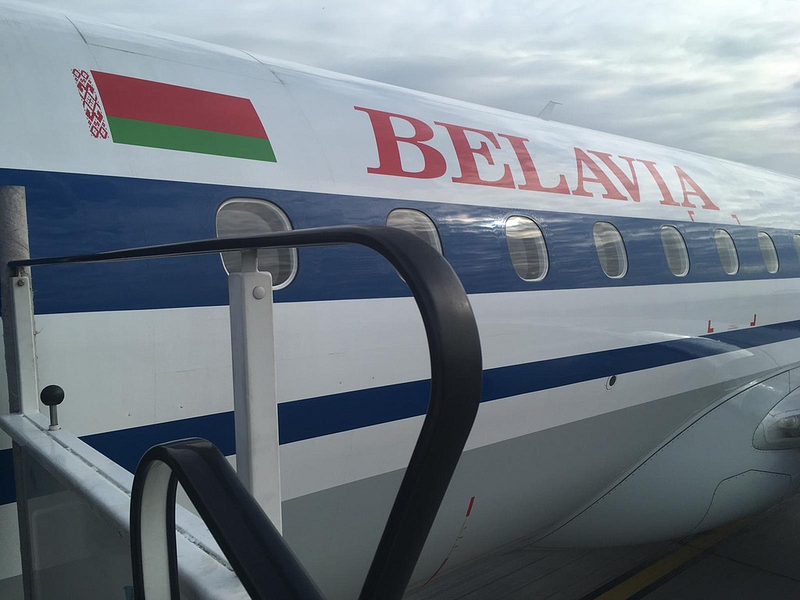
Incredible. The best technical guy David had ever worked with has a catchphrase. I tell Pavel that I will get back to him once I have figured out the flight details and we end the call. Next day I’m at my gate in the Berlin-Brandenburg airport waiting to board Belavia flight B2 891 to Minsk (before they got banned from flying to European cities).
Minsk
A couple hours later I’m at the hotel lounge in Minsk, waiting to meet Pavel for the first time in person. Pretty soon, a Belarusian bear walks up to me, a giant almost as wide as he is tall. So that is Pavel! Turns out he is kind and gentle behind his 1.9m frame. Pavel guides me to the mall next door, hundreds of Belarusians passing us left and right, we go escalator after escalator and finally arrive on the top floor. — a restaurant contrasting the mall of steel and glass. The Kitsch wallpaper made me think this is what it’s like to be in the USSR. All the young people working on their Apple MacBooks Pros couldn’t disturb me from feeling like I might as well be in a different decade. Pavel and I order beers (something I wouldn’t usually do during daytime, but when in Minsk!) and start talking–how we both started out with Salesforce, and the details of the opportunity before us. We arrange another meeting for the next morning before I fly back to Berlin.
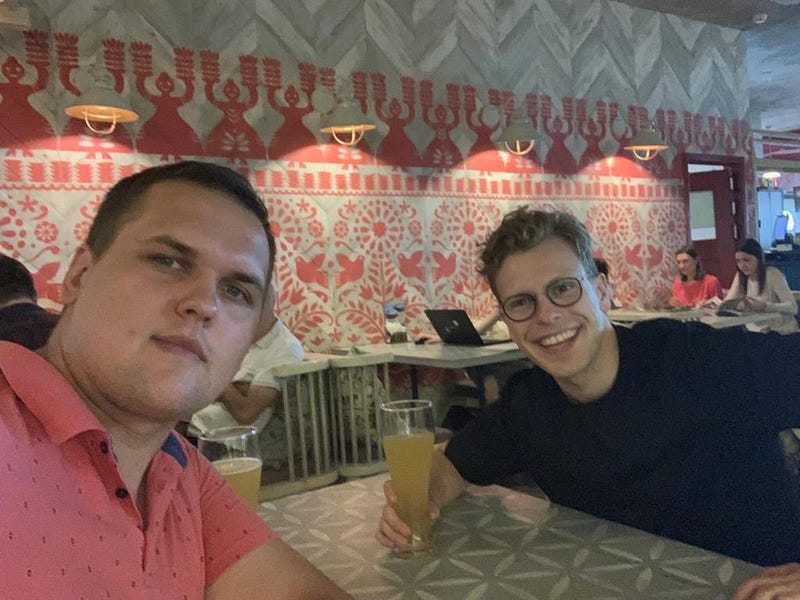
Pavel and me in Minsk. Notice the wallpapers.
Sitting in the Uber heading back to the airport, looking outside at the clean streets of Minsk (much cleaner than Berlin’s), I felt excited. I was going to meet at the client’s side the following week and come up with a plan to help them transform their customer service from a cost center into a profit center. And now I had Pavel, a deep technical weapon in our arsenal, to make it happen.
Four days later, I’m back in the airplane, this time on my way to Vilnius, Lithuania, from where I book a cab to get to Kaunas where the client’s tech team is. I meet with Pavel that night to grab dinner and learn more about his upbringing, what kind of projects he worked on and how it was to grow up in a former USSR country. I am starting to like the guy! We go to bed early to get in good shape for tomorrow’s meeting. We still had to win over the client’s tech team to make this happen!
Lithuania
The next morning we get to the office, basketball court outside, startup factory vibe inside. I like the place. Here we’re met by a kind and professional tech team, eager to understand what can be done with Salesforce and how the integration may work. All nine of us gather in a room big enough for four, and they start shooting technical questions at us, with Pavel responding in his reassuring way. I’d learned the simple “Ok” that bothered me in our first call was just Pavel’s calm nature, not a lack of enthusiasm, and a good contrast to my excitement and energetic personality. As Pavel handles the questions I can’t even understand, I observe the room, trying to gather what their tech team thinks. But at best I see poker faces, at worst skepticism.
Then Chris cracks a joke and everyone laughs… Maybe we are onto something here! Momentum shifts from rapid-fire questions to more of a conversation. They ask more questions about the business impact of Service Cloud and I step in and explain how they don’t have to deal with building a boring ticketing system. They can just buy it, build the APIs and focus on building the proprietary technology that drives the value in their business.
We manage to build the trust, and I’m probably more proud of that than anything–I’ve learned that it’s the most important part of running a business like this. We come up with a plan for how we can make the integration work from a technology perspective. That night I go back to Berlin, where the following day we meet with the client team to update them on the progress and define a plan to make it happen.
Thinking about it now, I want to briefly talk about what made this project so rewarding. It was a challenge. Both the deadlines were tough, there was a technology team on the client side that we had to build the integration with and there was the customer service team that we needed to get on board. More than 50 service reps, millions of customer records and hundreds of millions of travel records–a new level of scale that we wanted to prove ourselves against.
At the same time we had an energetic client team that helped make this come to life, a true team effort and a very rewarding project, especially when we managed to go live within the deadline that was communicated to the investors and make it a success. It also set a good foundation for our collaboration with Pavel, who would become our most important business partner in the first three years of building our company. We still work with him today!
Another benefit of that project was that we met a technology advisor, who I was a bit scared of in the beginning–Chris, who I mentioned earlier. He wasn’t a Salesforce fan at the time and was critical. On the other hand I quickly started to like him, because he has a no bullshit, hands-on mentality and was really interested in ultimately making the project a success. Plus, he brought to the table a lot of war scars from 20 years of working as a CTO and advisor in tech. Chris became a good friend and someone we like to do business with.
So how did it all turn out? Well, the first big project turned out to be a success for the client and for us. On January 1st 2020, we were officially in business. We transitioned from full-time work to freelancing to building a Salesforce consulting company, without taking on any venture capital debt. Valuent started with David, me, and our first two interns. A good start into an exciting ride that we are still at the beginning of as I write this from my sofa in my Berlin apartment on January 23, 2024.
Thank you for reading! If you enjoyed this piece, be sure to check out the previous articles in this series: Part 1: Stumbling onto the Right Problem and Part 2: Turning Ideas into Paid Jobs.