Kebabs to Vietnam Part 2/3: How we got our very first client
Part two of the Valuent founding story: how David and I landed our very first client.
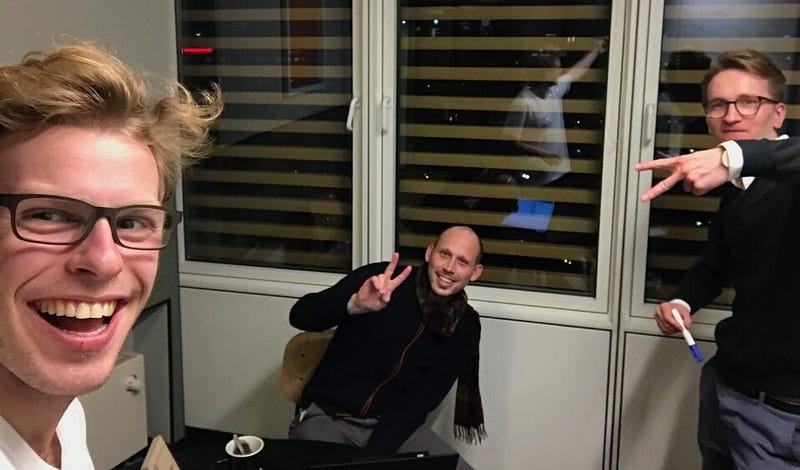
In Part 1 of this series, I told you how me and my business partner David stumbled onto the idea we built our company around. Now I’m going to tell you how we turned that idea into our first paid job.
It’s 2018 and I’m meeting my friend Julian for dinner. Julian was a colleague from my Rocket Internet days, who started his own company doing a pre-order food marketplace app. As we founders do, I start bragging a little about how I know this guy who helped us fix Salesforce at Enpal.
“Really?” Julian is skeptical. “We use Salesforce and I hate it.”
“Is that so?” I couldn’t help my curious smile. “Tell me more.”
A few minutes later my brain is in overdrive. I tell Julian to hang on a sec, walk outside, and call David–”I think we have our next unpaid gig!”. He’s game, so I walk back in and agree on a date with Julian that we meet at their WeWork on Potsdamer Platz to review their Salesforce org, in return for pizza and an office tour.
What did we learn from that first small unpaid project? A two-hour evening session allowed us to identify three workflows to speed up the process and a data model change that allowed Julian’s company to get the reporting they needed for their investor. The changes ensured they have a scalable setup, reduced the maintenance costs and costs for future changes. We were surprised by how quickly we could add value, especially when Salesforce was set up in-house by someone who had little prior experience with Salesforce.
Now we know we can provide value.
But can we also make money?
By early 2019, I was walking up and down the 18 sqm living room in my shared flat on Ohlauer Straße right below Görlitzer Park, asking myself this question on repeat. We’d decided to try freelancing two days a week, using the other five to work on our business. But how are we going to get some paying clients? Do I just cold call people? Then I had an idea.
I call my host dad Chris and tell him about the Salesforce freelancing idea and he goes, “Dennis start with the people you know.”
Genius. Right away, I call up my mentor Philipp Witzmann from the Helpling days, expecting him to say, “Dennis, so good you called, of course I have three Salesforce projects lined up for you. Do you want me to deliver them for you as well? Where do you want me to send the money?” That doesn’t happen. But Philipp has an idea: “Call Lars, I am sure he will be able to help you.”
Lars, really? I haven’t spoken to him in a while and what does he know about Salesforce anyways? Isn’t it awkward for me to call him after so much time and ask him about Salesforce projects? He’ll probably think, “What does this guy want from me?” But you know what, I call him anyways. And in case you are wondering? I am still walking up and down in my living room south of Görlitzer Park. “Beep, beep… Dennis, how are you?”
Within two hours of calling Lars, I had three customer referrals in my inbox. Turns out Lars had set up Salesforce for his old startup, and they liked it so much that they kept referring him to their friends. At this point Lars focused on building a sales consulting company and didn’t want those projects anymore. So he still had three recent project requests in his inbox and connected us to all of them.
Oh my god!
Thanks, Lars, but three projects is way more than I wanted. One was good enough. I didn’t even know what I was doing. So I call Lars again: “Dude, how does this work? Like, do we just go there and do it? Like when do we ask for money? Do we ask for money?” I already saw myself walking to this client with a suitcase to store all the money in. And then we hand it over kind of like a drug exchange, without the drugs.
Lars’ new company focused on training people how to sell. And Lars is a strong teacher. So, we meet with that first client in one of the few fancy pantsy high-rise buildings in Berlin for an evening session to understand what their business process should look like, what their Salesforce setup looks like and what they are hoping to get out of it, just like we had with Julian a few weeks before. But this time we didn’t come for pizza and an office tour. We came with a plan to make some money with our first paid project. And it works out.
Invoice #1 issued, 6 person days á 1200€ for a total of 7 200€ net.
Oh my god! There David and I are, sitting on the red sofa in my 18 sqm living room with our laptops, doing task after task and logging the time, basically counting the euros. We feel like geniuses.
And when we meet the CFO at the end of this first project, he tells us–and I will never forget it–“Guys, that was great. One of the best work sessions I have ever attended. I’d love to give you my testimonial and let me think about who I can recommend you to.”
Testimonials and recommendations? Remember Lars already sent three potential clients our way and that felt like too much. So I go, “Thanks that’s very kind, but we have more business on hand than we can do anyways. Thank you very much.” And that was it. I think the only other time I acted more out of course was when I was 16 years old watching Pirates of the Caribbean with a girl I met at a Palo Alto High School dance, and she asked me at the end of the movie, “Do you want to make out?” and I said, “No!” What was I thinking.
At this point, David and I still have no interest in starting a Salesforce consulting business. We’re in Berlin! I had worked at Rocket Internet and David for other WHU founders. Our expectation is still to build a venture-backed startup! But grinding +50 hours a week for someone else’s dream also means we don’t have the time to work on our own company, whatever that would be. Something needs to change. Fortunately, we now have an easy calculation to make.
Picture it: David and I sitting in my 350-Euro a month shared flat, laptops perched on a wobbly table loosely holding on to its legs (my flatmate and I broke the original glass plate while doing Raclette a few years earlier), he in his chic cable knit sweater, and me in my casual t-shirt (check out the photo if you like selfies), looking like a couple of wannabe-entrepreneurs–which we were!
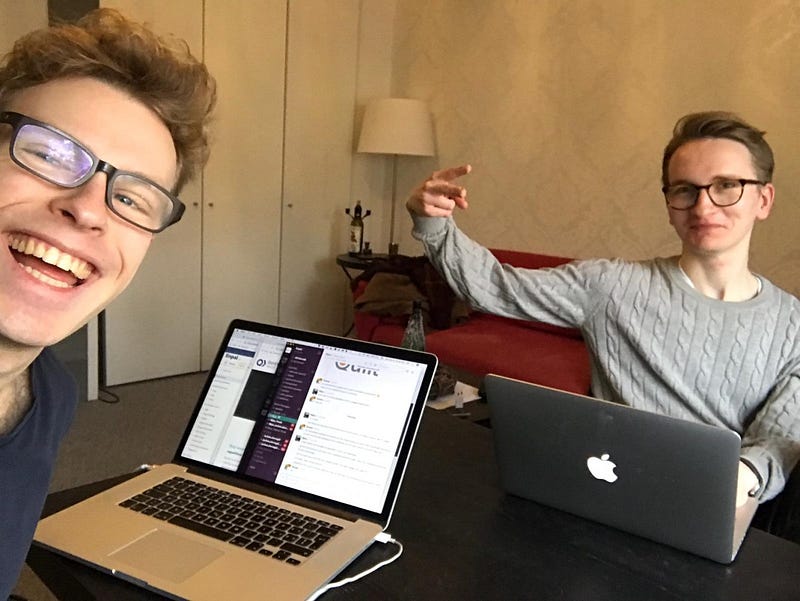
The early days David (right) and me.
It’s at this table we decide to go all-in. It was time–we had an idea and it was making us money. Why worry about VCs at this point? I made the first move and quit my job. David decided to hang onto his job, reducing his hours and then quitting a month later as we saw demand for our services going through the roof.
May comes, and, David tells me a recruiter reached out to hire him as a Salesforce expert. I don’t think much of it, since we’re not looking for full-time jobs. I neglected rule number one in Entrepreneurship: there are no rules. Fortunately, David didn’t forget. Who knows what this could lead to? He says to her, “Hey, we can solve your problem. Why don’t you start with us as freelancers?”
That paid off. David gets an invitation to have a döner (kebab) with Wolfi, one of the founders of the company the recruiter was calling from. I didn’t know who that was at the time, and frankly didn’t care. Fortunately David did go for that Döner though, because Wolfi was Wolfgang Heigl, the founder of HomeToGo, one of the big success stories in the Berlin startup scene! With David at the dinner, I think about Wolfi operating under the radar with an impressive track record, how he sold Swoodoo to Kayak, has a 200 people software development company in Lithuania and went on to IPO HomeToGo. I have a hard time believing this is happening. But Wolfi must have liked what David told him.
Wolfi tells David to get on a train with his partner (aka me!) and go to Hamburg with people from his management team to look at the service department of a company they recently acquired. Wolfi’s briefing for David: “Just take a look and let us know what you think we can do there with the Salesforce Service Cloud. And yeah, just charge us your daily rate.”
What? He never even asked what our daily rate was. Our most recent daily rate at the time was 1600€. So we thought, well let’s do 1500€, we don’t want to be greedy.
Thinking about this, I can still hardly believe it happened. I get goose bumps writing about this. At the time, I didn’t understand at all what he saw in us, or how we were making this work. In hindsight, I realize that our experience building companies is what we were drawing on now.
Ok, back to the story. It’s Tuesday morning May 7th 2019, when David and I get on board the ICE to Hamburg to take a look at the service department of the company they acquired.
We are now at the acquired companies HQ in Hamburg. We enter the board room, nine people sitting on one side of the long conference table. Our delegation sits down on the opposite side. The tension is palpable, the company had just been acquired and now the management from the acquirer is there and they even bring outside consultants to sniff around. But hey, David and I are nice people, and have no hidden agenda. After all, we are just there to assess how Salesforce Service Cloud might help their customer service to serve their customers better.
And you couldn’t pay for this. We learned so much during that day.
Fun fact, the CEO of the acquired company called himself the circus director, I think that day he felt more like a doll in a puppet show. It didn’t feel like he was going to direct the show for much longer. So in that delicate setting we tried our best to form a bond with the local team and get them on board.
What did I learn that day? Well, I learned that it’s not just the technical knowledge and the business knowledge combined that is important. But also the tact to build a relationship with the team at the acquired company, to build trust and set a foundation that makes the introduction of Service Cloud a success. Because you have to take the people with you, so they actually use it. To sum up that day up in Hamburg: We see a lot of potential to streamline the customer service operations and improve the customer experience with the help of Salesforce Service Cloud. And Wolfi shares his vision of turning the customer service into a profit center.
“We can help with that.” On our way back we brief their COO on what we think is possible. They have a tight deadline and need an integration with the backend to make this project happen. The next day we’re invited to a WhatsApp Group with Chris, who’s there as an external consultant, and whose job it is to assess the overall health and risk profile of the project.
Before they commit to this project they want to get more proof–was this project doable within the deadline and could we deliver? An important piece in this project was the integration with their backend data, which requires deep technical expertise. Neither David nor I had ever worked in the Apex Code environment of Salesforce (the Salesforce software developer environment). But since the developers from the client wanted to test the API, we had to set up something. And so there I was. Playing around with the Salesforce Developer tools for the first time. And the last time.
I eventually got it to work that day, but one thing became clear: If we wanted to deliver this project successfully we couldn’t do it alone.
Join me next time when I head to Minsk, Belarus to find help.
Thank you for reading! If you enjoyed this piece, be sure to check out the previous article in this series: Part 1: Stumbling onto the Right Problem and stay tuned for the next part: Part 3: Moving from Wannabe Entrepreneurs to Serious Business.