A guide to everyday persistence
The underrated skill founders, operators, and creators quietly master.
The underrated skill founders, operators, and creators quietly master.
What is persistence?
Persistence is not taking no for an answer. If you want something you find a way to get it. You navigate around the obstacle or you insist your way through it.
Many people let things slide even when they don’t want to, frightened to come across as obnoxious or a jerk. It’s important to differentiate between persistence and obstinacy (more on that in Paul Graham’s essay “The Right Kind of Stubborn”). High level goals are important and one should persist as long as they make sense. But having freedom around how to get there marks the difference between persistence and obstinancy. The goal of developing your persistence muscle is not to get stuck on one way of thinking or doing things, but to think about your options. What can I make possible if I really want this?
This is persistence, and I trust your judgement to use it wisely, but people tend to err on the side of giving up too quickly, which is why I’m writing this essay.
The good thing about persistence is that it can be learned. I like to think of it as a muscle–everyone has it.
Look at toddlers struggling to walk stairs and yet doing it again and again, falling on their butts… They are incredibly persistent. I think persistence is the natural state of being.
If you can walk, you’ve already demonstrated persistence.
But what do I know about persistence? I’m persistent, and some people find it annoying, but it has led to an interesting life and some of my best achievements. But my mom always said I have “strong will” (especially when I wouldn’t stop playing Zelda on N64), which I think of as persistence. Some of the benefits I’ve gotten out of being persistent:
- A high school exchange in Palo Alto (Silicon Valley) by sharing enthusiasm
- A 1.3 Abitur grade point average (by not accepting certain results and communicating why they mattered)
- Getting admitted to University of St. Gallen (by finding different options to prepare yourself to maximize your chances of success)
- Becoming a Country Manager at Helpling at the age of 25 (if you want something, ask for it)
- Being the 5th employee at Enpal (which turned out to be a unicorn) by following up again and again
- Closing a multi-million Euro deal in the first year of operation of my company (when you see a thread of opportunity, pull on that thread)
…and many other fun and rewarding experiences, some of which I’ve written about!
How to train your persistence
How do we train our persistence? Experience shows you hone it in simple everyday situations.
First, you need to recognize everyday opportunities where you can persist. This will help you build up your persistence muscle.
Often people accept things too early. I can’t do this because ‘so and so’ said so. Well really? A better question might be, “do the laws of physics prohibit this?” No? Then use your mind to find a way to get to your goal. If it’s worth pursuing that is.
What practicing persistence in small ways can look like
Here are some everyday situations that I’ve found useful to train the persistence muscle. Think of them as a gym, where you build up the confidence to persist when it matters later on.
- Making dinner reservations. Restaurant says, “we are full.” I say, “no problem, we’re just two people and happy to sit at the bar.” Still full. “Omg you guys were highly recommended. Is there a chance to come half an hour earlier or later that would help you?” When they don’t talk, just shut up and wait. When they say “no” again, say “we only need 90 mins. Is there any chance?” They usually think and look for options and at least in 30% of the cases I still get a table at the restaurant, despite them initially saying they are full.
- Asking for a neighborhood discount when you make a purchase. I live close to Kudamm, a Berlin street that’s cornered by LVMHs brands. So I’m looking to buy a new backpack. When I find the right one (695€), I ask for a neighborhood discount, to which the sales clerk responds “we don’t usually do that here.” All I heard was “usually” and that meant, it can be done. So I ask under what circumstances they do give discounts “well if you’ve made a lot of previous purchases.” … “First I need to make one, wouldn’t it be great if that was today? A small friendly neighborhood discount would help me make a decision.” He was not ready to budge. So I tried a few different angles, until he said “Ok, we can do 5%.”
What’s holding you back and how to make it fun
Here are some limiting beliefs that may hold you back from achieving what you want. And a reframe to help overcome them.
- “I don’t want to be a burden” is a dangerous belief, because it gives you an excuse to not persist and just go with what is initially offered.
- “It will make me look like a bad person” or “I might look like a fool” are empathetic concerns, because we hate to look bad in front of others. But I think if it’s not at least slightly awkward, you’re probably not persisting enough.
- “It was not meant to be.” This is a fine line. One that often is used to accept something.
- “It should come naturally.” That sounds so romantic, right? I think a lot of great achievements have come in every way, but not in what we would consider “natural.” Has a lot of energy been wasted on things that did ultimately not come to fruition? Probably.
I struggle with these excuses, too. Recognizing them gives us a chance to choose whether to persist or not. My favorite chapter in Stephen R. Covey’s “The 7 Habits of Highly Effective People” is the one on being proactive (shoutout to my friend Jaris, who made me read it at 16. I hated reading at the time). Stephen talks about reactive language like “I must” or “I can’t” vs. “I choose” or “I prefer.” Noticing the above excuses helps to move from reactive to proactive.
I hope this sharpens your sense to not fool yourself. Ask yourself, am I making an excuse or is this really not possible? It’s possible but I’m not willing to pay the price right now, is an intelligible and honest answer. Saying, I can’t when really you can, is not being honest with yourself and the equivalent of muscle atrophy for your persistence muscle.
Let’s say you agree with the above and you notice the excuses. But you’re still not convinced. Let me offer you a reframe that has worked for me.
Instead of being worried about causing trouble, think about times where you were able to help someone else. For example you gave up your seat on the bus for an elderly person. How did that make you feel? Did it cause you slight discomfort? Maybe. But didn’t you feel great about the smile on their face and knowing that you did something that feels noble and right? It sure did.
But what does that have to do with persistence? More than you think. Because ultimately the people who you persist to might become your accomplices in achieving your goal. Wouldn’t it be nice if you can give their work some meaning by doing something outside of their usual routine?
Let’s imagine it’s your anniversary and you’re in Paris. There’s this one restaurant with that view of the Eiffel Tower that your wife loves so much. It would mean the world to her to have dinner at that table, looking at the sparkling lights of the Eiffel tower. But the table is already taken.
Now wouldn’t it mean the world to you to arrange that table for your wife? Imagine you can make the restaurant staff accomplices to your plan and get that table. You share your gratitude with them. This may be something they’ll remember for the rest of their lives. So you’re not a burden. You offer them a chance to make a difference in someone else’s life and just like you offering that chair to the elderly on the bus, you can help them feel good about themselves.
Which is also why I prefer to be playful when I persist. Sometimes things don’t work out and usually it feels better to maintain a certain playfulness.
The pink Polo hat
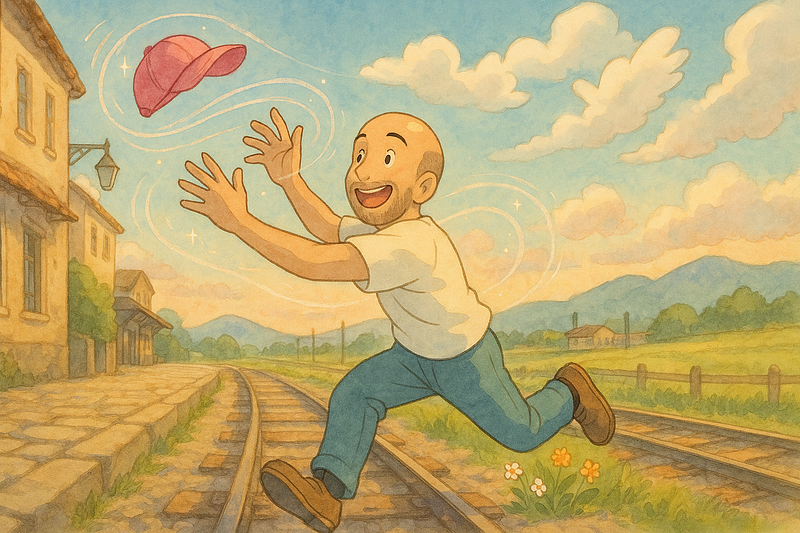
But sometimes, they work out amazing. Last week I was at Markthalle 9 in bustling Kreuzberg with a friend who told me about his train trip to Budapest. Just when he exited the train, he noticed that he had forgotten his pink Polo cap in the Bord Bistro.
Maybe you’d think, it’s just a hat, no big deal. But this hat meant a lot to him. It was a gift from his exchange to Rome, and it happened to fit perfectly. So he calls the train service who tell him to call back in 30 mins. He does, and learns that the cap wasn’t found and nothing can be done.
My friend said to me that he’d thought to himself, ”What would Dennis do?” (This friend knew I’d once spent 2 hours with customer service in the South of France to fix a rental car fee problem when I was a student.) Certainly not give up.
So he calls the customer service line again, this time he has a more helpful agent (persistence benefits from some luck). Two calls and one day later he’s entering the Fundbüro at Prag station and to his own disbelief sees a pink Polo cap in the back of the corner of the room right behind the service lady (he showed me the picture on his iPhone). The lady at the Fundbüro could hardly save herself from getting a kiss of joy from him. I’m sure the phone operator and the friendly Fundbüro lady will remember my friend and his pink cap for a long time.
Now go out and do it
I hope that reframe helps you notice opportunities to persist, makes you aware of potential excuses and motivates you to practice your persistence muscle. I don’t think this is easy. I have to nudge myself every now and then to recognize where to persist and then to take action. And, results are not guaranteed. But you have to give yourself a shot. So remember to ask for that neighborhood discount–you really never know until you try.